
Target-specific AI/ML workflows for oral-small-molecule discovery
ArrePath moves from target selection to validated, deployed target-specific AI/ML workflows in about four weeks, then explores novel chemistry at machine scale.
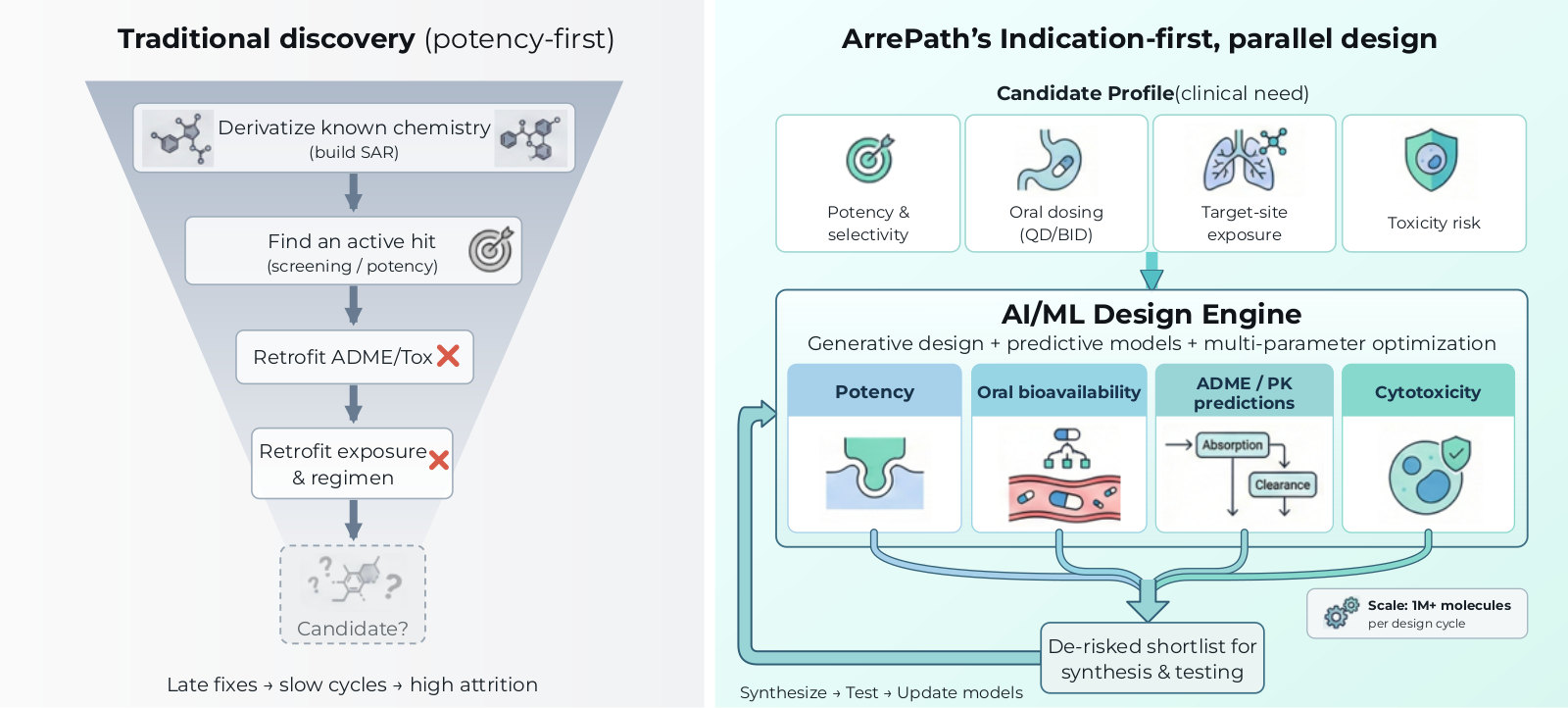
Define the indication first, then design the molecule
Potency, oral bioavailability, ADME/PK, and cytotoxicity are designed in parallel against an indication-specific candidate profile.
Three ways the platform delivers
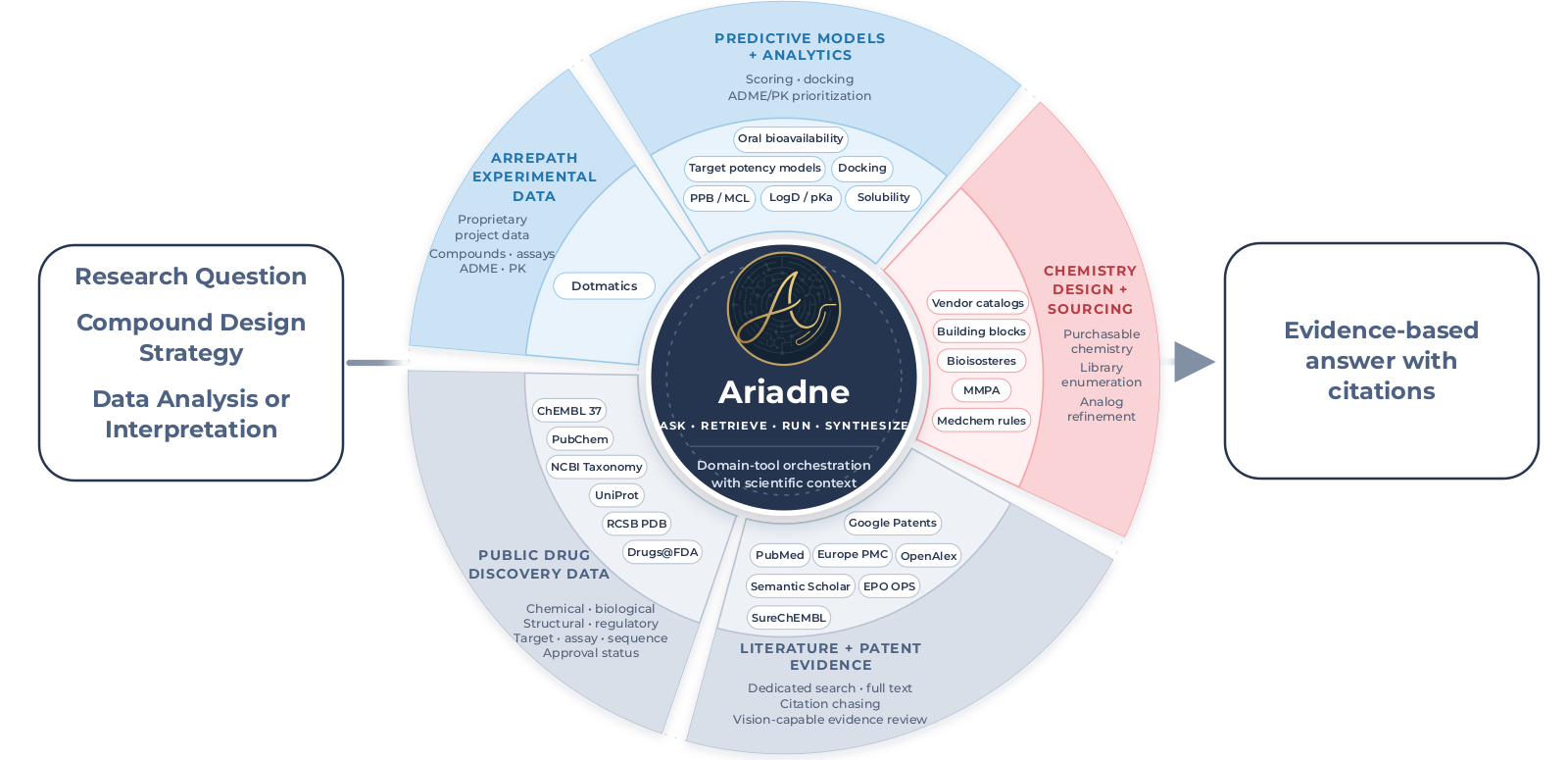
Ariadne: evidence-powered scientific copilot
Ariadne connects proprietary experimental data, public drug-discovery data, literature and patent evidence, chemistry design, and predictive models to turn scientific questions into evidence-backed answers with citations.
Design across the whole candidate profile
Production models span potency, clearance, solubility, plasma-protein binding, cytotoxicity, oral bioavailability, and related PK properties. These properties are considered together from the start rather than retrofitted after potency optimization.
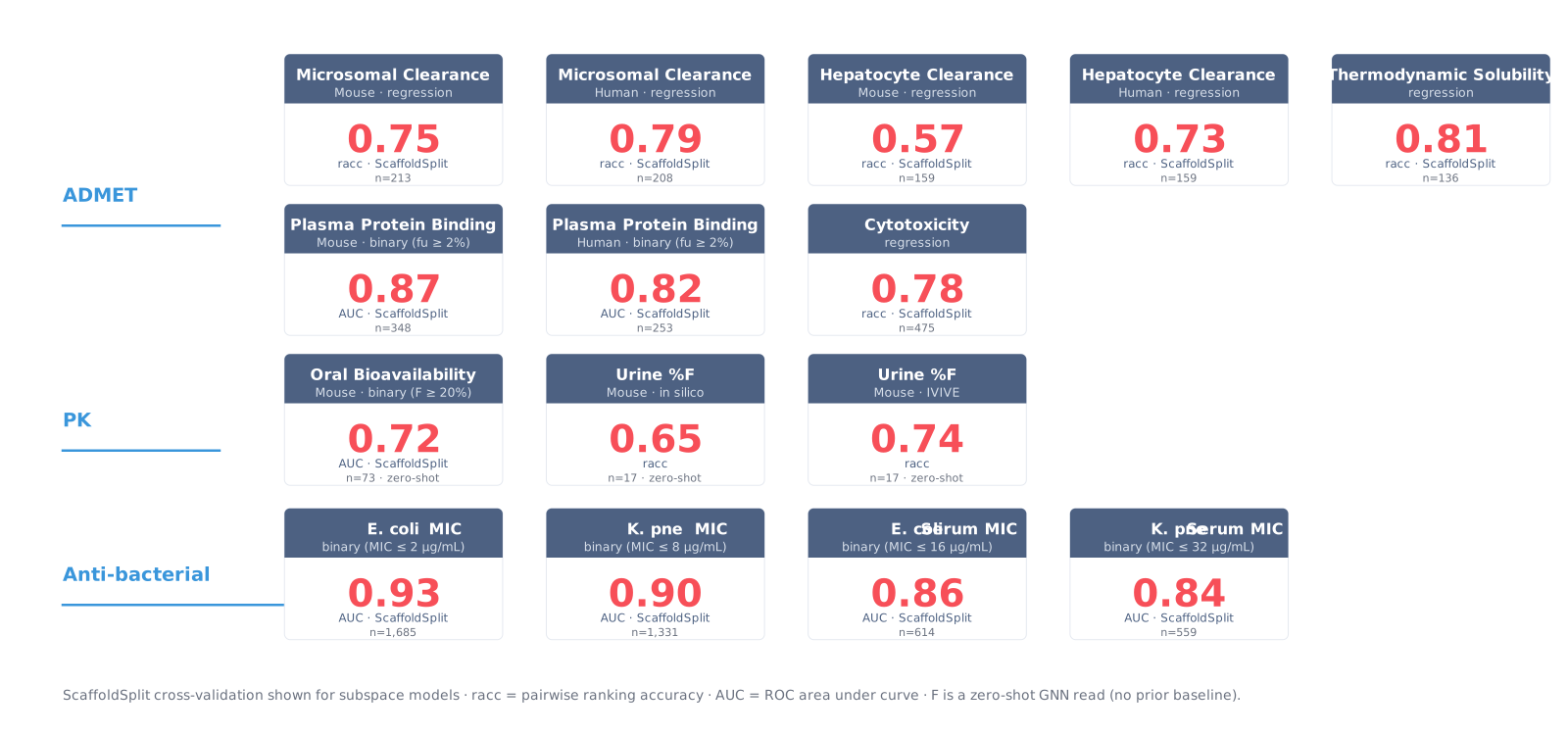
Heterogeneous data is an asset, not noise
Most scientists and ML practitioners discard substantial amounts of bioactivity data because absolute values do not reproduce across assays. ArrePath learns the reproducible signal across those assays instead.
- Learn rank orders, not absolute values — they reproduce across assays
- Use scaffold-agnostic molecular representations — generalize beyond a chemical series
- Result: models that zero-shot generalize to new chemistry
Our models generalize where public models fail
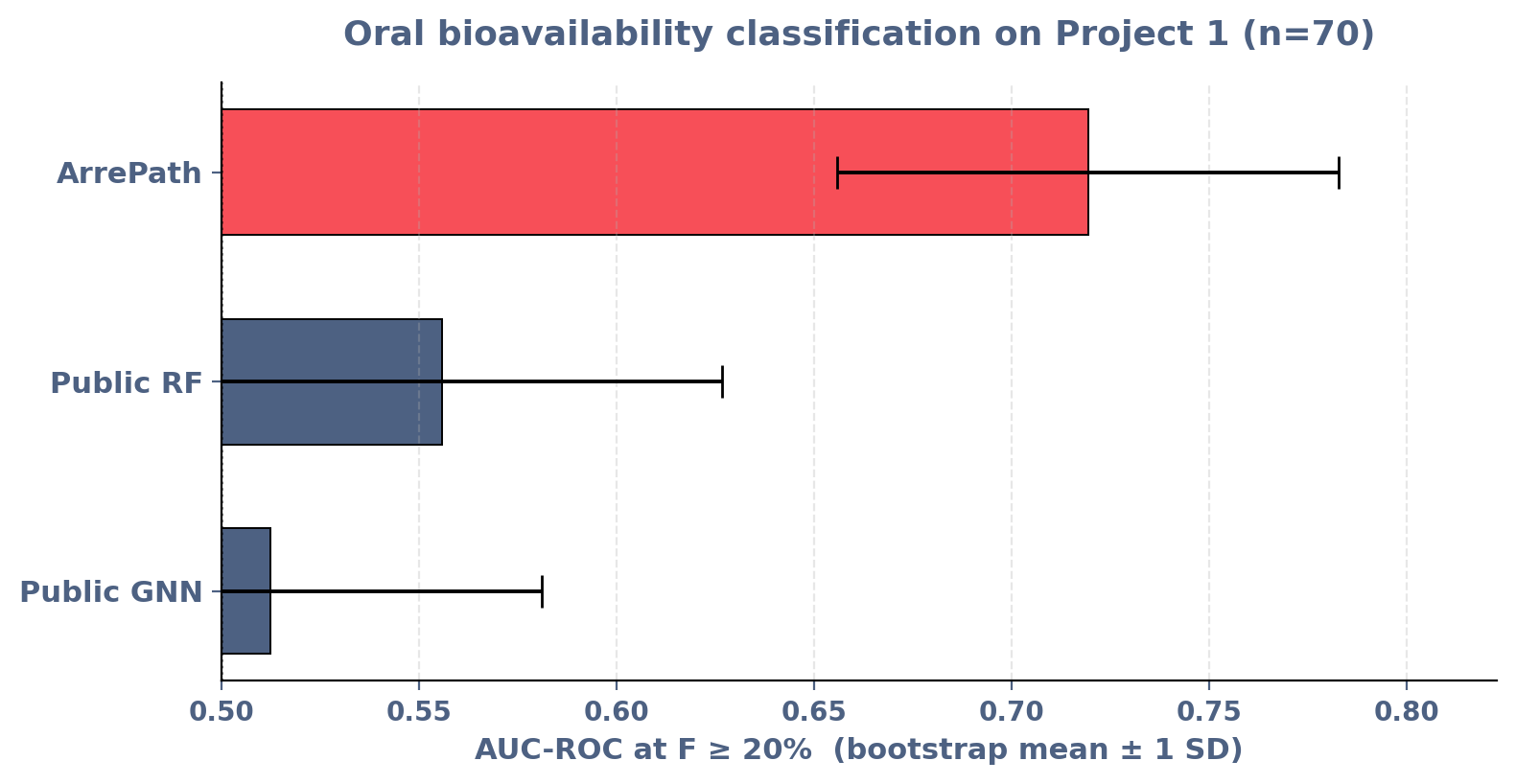
Predict oral bioavailability of our lead-series compounds — our model had no training data on this chemical series.
- ArrePath model: AUC-ROC ≈ 0.72 (zero-shot on the lead series)
- Public Random Forest: ≈ 0.56
- Public GNN: ≈ 0.51 (essentially random)
Cross-scaffold, cross-assay rank-order training is what enables generalization.
One platform, multiple programs
Reusable models, consistent data treatment, and target-specific workflows support programs across the updated pipeline.
Strategy & Pipeline →