Project 1: Outpatient UTI

Novel MOA oral antibiotic targeting MDR Enterobacterales and CRE

Gram-negative AMR: the global context

Antimicrobial resistance drove an estimated 1.27 million deaths globally in 2019 and over $4.6 billion in U.S. healthcare costs in 2017. Antibiotic R&D has declined sharply over the same period — roughly 80% of recent approvals are derivatives of known classes, leaving a sparse pipeline against resistant Gram-negative pathogens.

A novel mechanism

A clinically novel mechanism with no cross-resistance to major existing Gram-negative resistance pathways — confirmed against MDR, MBL, and CRE isolates.

Target

  • Oral LpxH inhibitor
  • Clinically novel; distinct from existing antibiotic classes including LpxC
  • No human homolog; highly conserved across Enterobacterales
  • Validated in vitro and in vivo

Microbiology

  • Bactericidal mechanism
  • Low resistance frequency (~1 × 10⁻⁹)
  • MIC90 ≤ 4 µg/mL across MDR, MBL, and CRE isolates
X-ray crystal structure of the lead compound bound in the active-site pocket of its bacterial target, shown as a cartoon ribbon protein with the ligand rendered as a space-filling surface.
Crystal structure of the lead compound bound to LpxH

Outpatient UTI: our entry indication

Drug-resistant UTI is rising in the community, with a roughly 5× increase in NDM-1 CRE driving escalation to IV therapy. Outpatient UTI represents a $1B+ peak sales opportunity, and existing oral options have limited or no CRE coverage — the gap where unmet need and commercial pull align most sharply.

The mechanism is applicable across Gram-negative AMR more broadly; UTI is the lead indication where commercial pull is strongest.

Status

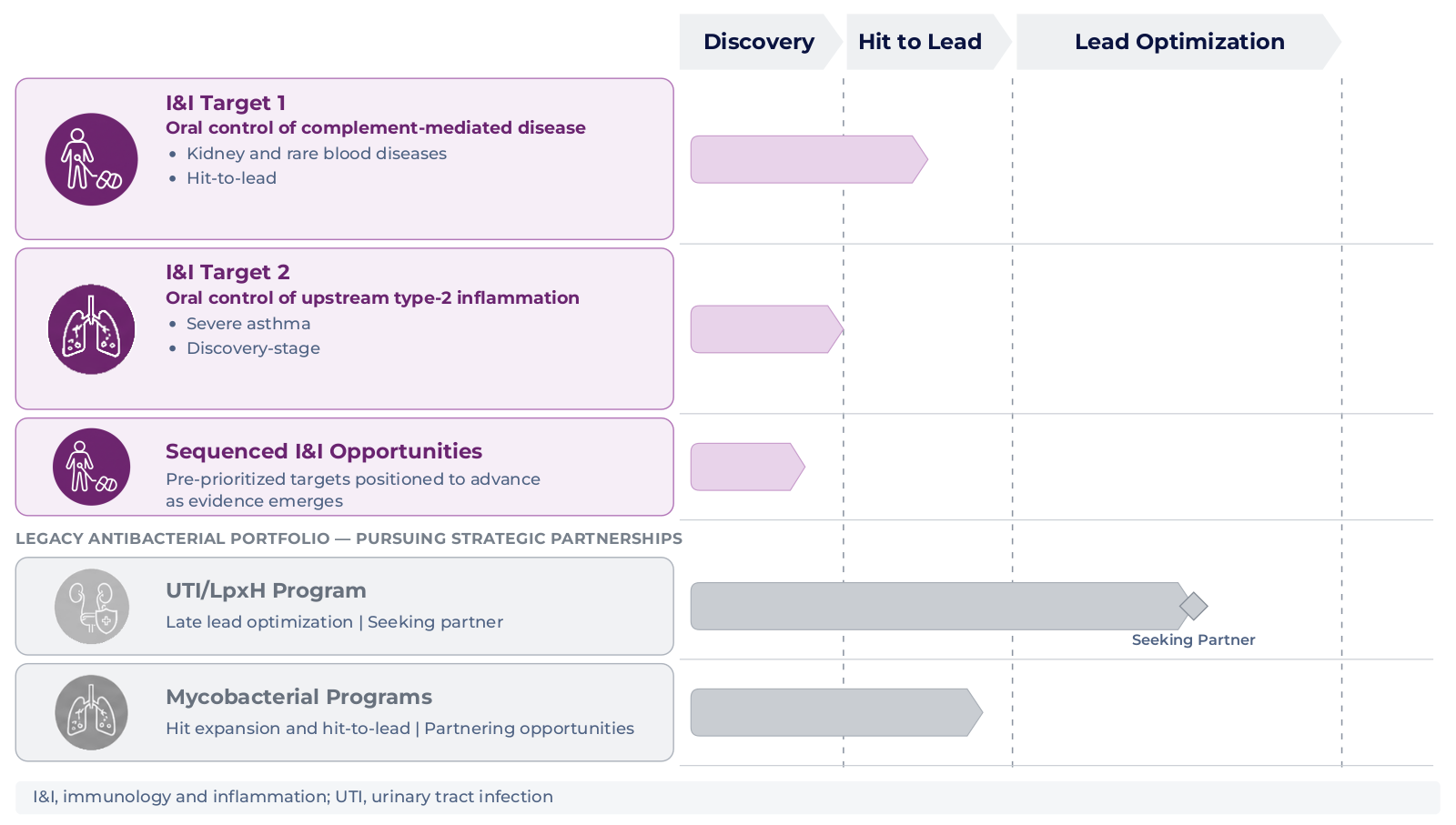
Late lead optimization — preDC nomination targeted 2Q 2026. Favorable in vivo efficacy and ADMET properties support that progress:

  • Demonstrated efficacy in established preclinical UTI infection models
  • Promising solubility and metabolic stability in human hepatocytes
  • Oral bioavailability and minimal cytotoxicity

Project 2: NTM Lung Disease

Advancing novel oral compound classes for NTM — a multi-billion-dollar opportunity

Market Strategy. Approximately 50,000 U.S. patients with M. avium complex (MAC) are served by a single approved drug (Arikayce, inhaled-only), and the ~15,000 U.S. patients with M. abscessus (MAB) have no approved therapies. Current regimens are old antibiotics repurposed for NTM with non-optimal PK and tolerability, and recent clinical setbacks have left no oral agents in active development for MAC.

Novel Mechanisms. Novel oral classes designed for NTM from program initiation; targeting M. abscessus and M. avium complex; AI/ML enabled from day 1.

Status. Hit-to-Lead (M. abscessus); Hit Expansion (broad-spectrum); early hits identified for tuberculosis.

Platform and pipeline have advanced together

Quarterly milestones — ML platform buildout alongside Project 1 and Project 2 progression

Three-track timeline showing ArrePath's AI/ML platform buildout milestones (PPB and microsomal clearance, E. coli activity models, cloud deployment, solubility and docking, LogD, library enumeration, pKa, electrostatic and shape similarity, generative models, oral bioavailability, Project 2 target model, improved ADME and clearance) alongside Project 1 progression (Hit Expansion to Lead Optimization to planned DC Nomination) and Project 2 progression (Hit Expansion to Hit-to-Lead to planned Lead Optimization), spanning Q2 2022 through Q3 2026.

ArrePath is building a differentiated pipeline addressing significant unmet need across therapeutic areas

ArrePath pipeline: Project 1 Outpatient UTI lead program (oral LpxH inhibitor); Project 2 NTM lung disease and tuberculosis programs

Supported by leading antimicrobial-funding organizations

CARB-X — Combating Antibiotic-Resistant Bacteria PACE — Pathways to Antimicrobial Clinical Efficacy

Connect With Us

Interested in learning more about our strategy, or in discussing a
partnership? Contact us to get the conversation started.

Contact Us